Engineering Sovereign Application Portability with Adaptive Apps and Radius
Engineering Sovereign Application Portability with Adaptive Apps and Radius
Date: 2026-09-15
Learn how Adaptive Apps and Radius empower true application portability across sovereign and hybrid cloud environments, turning portability from theory into engineered reality.
Tags: ["Adaptive Apps", "Azure", "Radius", "Sovereign Cloud", "Cloud Portability"]
Most organizations maintain an exit strategy for their cloud investments, but until recently, application portability was more aspiration than engineered capability. What if you could not only design for portability but also build, test, and prove it reliably across diverse sovereign and hybrid cloud environments? That is the paradigm shift explored by Thomas Maurer in collaboration with Dylan de Jong, Microsoft's Chief Architect for Sovereign Cloud in Europe North.
Sovereignty has evolved beyond the simple question of data residency into a far more complex application-level challenge: not only where data lives matters, but where an application can run next—and how quickly it can be redeployed elsewhere—matters more. This blog post uncovers how Kubernetes laid the groundwork for portability but newer innovations like Adaptive Apps and Radius take it to new heights. We'll break down how these technologies work together to empower organizations to build once and deploy anywhere, with governance and consistency baked in.
In this article, you'll discover the architectural pattern behind sovereign application portability, see how Radius operationalizes this vision, and learn practical tips for building truly portable applications in modern Kubernetes-based platforms.
Architecture Overview
(Architecture diagrams and detailed visuals are available in the original article by Thomas Maurer.)
Key Technical Observations
-
Adaptive Apps Extend Kubernetes' Promise
Kubernetes standardized container orchestration but left platform-specific capabilities like databases, messaging, and policy diverse and fragmented. Adaptive Apps create a unified application model that moves not just containers, but all capabilities and dependencies—enabling true portability. -
Radius as a Control Plane Enables Platform Neutrality
Radius operates as a Kubernetes-native control plane, decoupled from application code. It manages resource types, recipes, and environment bindings to flexibly resolve workloads with local implementations, preserving existing infrastructure investments. -
Platform-Defined Recipes Decouple Infrastructure Detail from Developers
Developers declare capabilities (e.g., PostgreSQL database) once. Platform teams configure environment-specific recipes using tools like Bicep or Terraform to decide how those capabilities are provided natively per environment. -
Central Governance with Distributed Deployment
Recipes, policies, and identity standards remain centrally governed by platform teams, enabling compliance and security mandates while freeing developers to deploy seamlessly across on-prem, sovereign clouds, and public clouds. -
Portability Requires Deliberate Architectural Choices
Beyond just container portability, successful projects plan thoroughly for data migration, schema compatibility, latency, identity federation, backup, and compliance. Early validation across environments transforms portability from wishful thinking to proven capability. -
Leverages Existing Azure and Kubernetes Ecosystems
Radius reuses Azure Verified Modules, landing-zone patterns, and Terraform/Bicep templates, easing enterprise adoption and reducing rework—a pragmatic bridge between current investments and future sovereignty demands.
How It Works
Defining the Application Model Once
Developers specify their application workloads, capability needs, and connections through a single declaration. This includes not only container images but also contracts for supporting resources such as databases, message brokers, identity providers, and AI models. For example:
resource app 'app:1.0' = {
  name: 'myapp'
  capabilities: {
    database: 'PostgreSQL'
    broker: 'EventHub'
    secrets: 'KeyVault'
  }
}
This model remains stable across all environments, encapsulating what the application requires.
Platform Configures Recipes per Environment
Platform engineers implement recipes—declarative infrastructure definitions in Bicep or Terraform—that fulfill the declared capabilities with environment-specific resources.
| Component | Purpose |
|---|---|
| Application model | Describes workloads and capability contracts once |
| Resource types | Portable contracts like database, broker, identity, AI model |
| Recipes | Implement contracts in Bicep/Terraform per environment |
| Environments | Bind recipes, providers, policies, and parameters to target clusters or cloud platforms |
| Control plane & graph | Resolves deployments, tracks state, and manages dependencies across environments |
This separation means the same application model can deploy unaltered to Azure Public Cloud, Azure Local, Arc-enabled Kubernetes, or other Kubernetes platforms.
Radius Control Plane Connects it All
Radius acts as a Kubernetes-native control plane that overlays the platform. It resolves the application model, consults environment bindings, and applies the right recipes to create or update resources. Radius maintains the deployment graph and state, showing dependencies and ensuring consistent rollout with local platform standards enforced.
Deploy Anywhere, Govern Centrally
Operators retain governance over policies, identity, networking, and observability at the platform level while developers deploy consistently. This multi-layered approach fosters agility without compromising sovereignty or compliance.
Quick Tips & Tricks
-
Decouple Application Logic from Infrastructure Detail
Design your app to declare capability needs, not specific resource endpoints. Let the platform map these to concrete implementations via recipes. -
Leverage Existing IaC Investments
Use your existing Bicep or Terraform modules as Radius recipes to jumpstart platform adoption while maintaining familiar workflows. -
Automate Environment Bindings Early
Validate environment-specific configurations with continuous integration pipelines testing deployments in all target contexts to catch divergence early. -
Enforce Policy via Control Plane
Use the Radius control plane to enforce security, compliance, and network policies consistently across all deployments without developer intervention. -
Prioritize Schema and Data Compatibility
Prioritize compatibility of managed services especially databases and messaging to minimize migration friction when moving applications. -
Contribute Back Recipes and Extensions
The Radius project is open source—share your environment recipes and enhancements to benefit broader community sovereignty and portability efforts.
Conclusion
Adaptive Apps and Radius represent advances in how organizations approach sovereign cloud portability. They shift portability from a vague aspiration into an engineered, testable capability—empowering teams to build once, deploy anywhere, and govern centrally. This has important implications for organizations grappling with changing residency requirements, compliance mandates, and multi-cloud strategies.
As the ecosystem matures, expect this pattern to become a foundational pillar for hybrid cloud, sovereign cloud, and edge deployments alike. For architects and platform engineers, embracing this modular, environment-agnostic approach will reduce complexity and accelerate innovation—making true cloud sovereignty a practical reality.
This article is based on the original work by Thomas Maurer and insights from Dylan de Jong, Chief Architect for Sovereign Cloud Europe North at Microsoft.
References
- Sovereign Application Portability with Adaptive Apps and Radius - Thomas Maurer — Original article explaining the concepts with insights from Microsoft experts
- Build Portable Applications with Adaptive Apps - Microsoft Docs — Official Microsoft guidance on Adaptive Apps application models
- Designing for Cloud Sovereignty with Radius and Dapr - Microsoft Tech Community — Deep dive on Radius and its integration inside cloud sovereign strategies
- Azure Local and the Microsoft Sovereign Private Cloud — Related post on hybrid and sovereign cloud environments
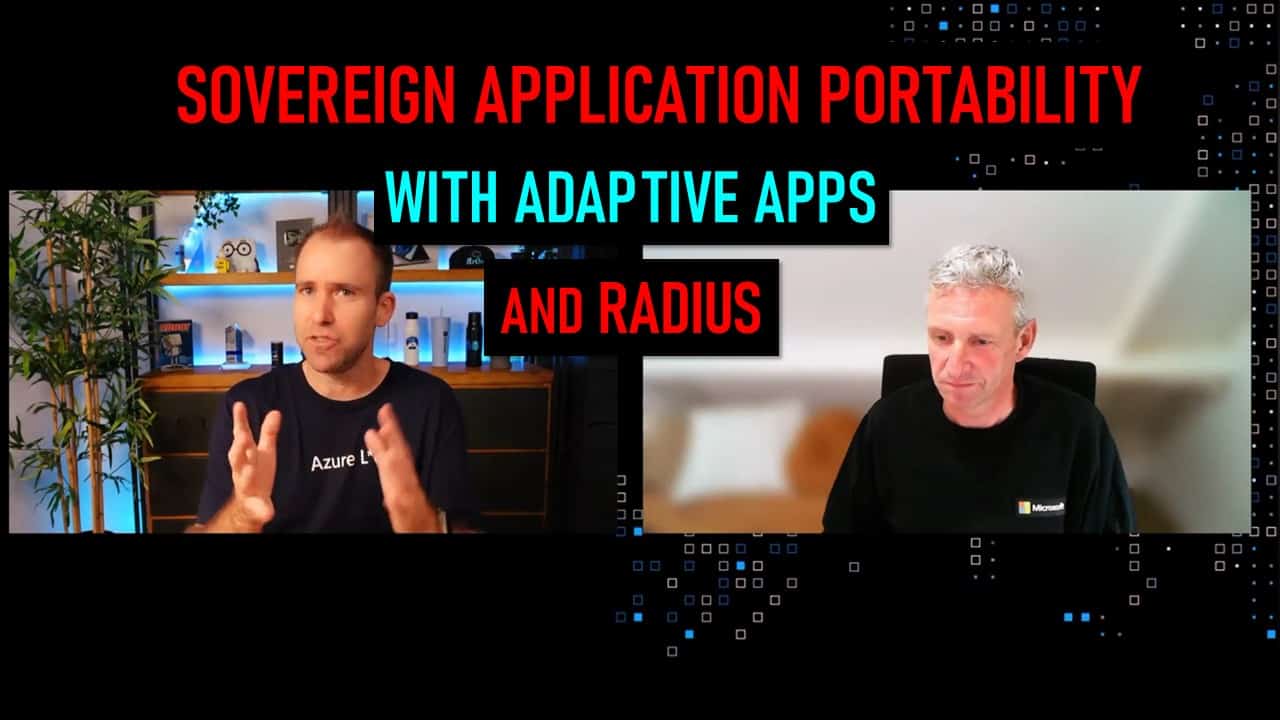
Image credit: Thomas Maurer