Mastering AI Agent Governance: Controlling Costs and Proving ROI with Microsoft Foundry
Mastering AI Agent Governance: Controlling Costs and Proving ROI with Microsoft Foundry
Date: 2026-09-11
Unlock precision in AI investments by mastering agent governance to control costs, enforce budgets, and demonstrate clear ROI using Microsoft Foundry.
Tags: ["Azure", "AI Foundry", "Cost Management", "AI Governance"]
Artificial intelligence agents are rapidly becoming foundational to enterprise innovation, yet their complexity often obscures how much they cost and what value they truly deliver. Without rigorous governance, AI workloads risk spiraling expenses and unclear returns, frustrating both developers and business leaders.
Microsoft’s approach to AI agent governance, articulated through Microsoft Foundry, offers a transformative way to see, control, and optimize AI agent spending while linking investments directly to measurable business outcomes. By enforcing spend limits, applying consistent policies across models and providers, and continuously measuring agent value, enterprises unlock a reliable framework for scaling AI responsibly and cost-efficiently.
In this post, we'll explore how agent economics are managed end-to-end in Microsoft Foundry: from granular cost observability to financial budgets, through transparent ROI dashboards and optimization strategies. If you're building or managing AI agents, understanding this governance cycle will help you align AI innovation with cost discipline and prove your AI investments pay off.
Key Technical Observations
-
Comprehensive Observability Through Traces and Metrics — Foundry collects granular traces that reveal each agent’s model calls, tool invocations, token usage, retries, and latency, enabling precise identification of costly or inefficient behaviors before they escalate.
-
Multi-layer Spend Controls with AI Gateway — Token limits and request quotas are enforced per project and model deployment, reducing risk of runaway consumption in real time, while policy consistency applies uniformly across different AI providers and models.
-
Continuous Quality and Safety Evaluations — Automated evaluations monitor output quality, safety, and task completion rate to ensure cost reductions do not degrade user experience or business outcomes, facilitating informed tradeoffs between model size and effectiveness.
-
Financial Budgeting Integrated into AI Governance — Budgets with alerting and escalation wired into Azure Cost Management provide accountability across teams, creating financial guardrails that complement technical quotas.
-
ROI as a Core Metric, Not an Afterthought — Foundry measures net value by subtracting total cost from value generated, visualizing ROI to inform decisions whether to optimize, expand, or retire AI agents based on their economic impact.
-
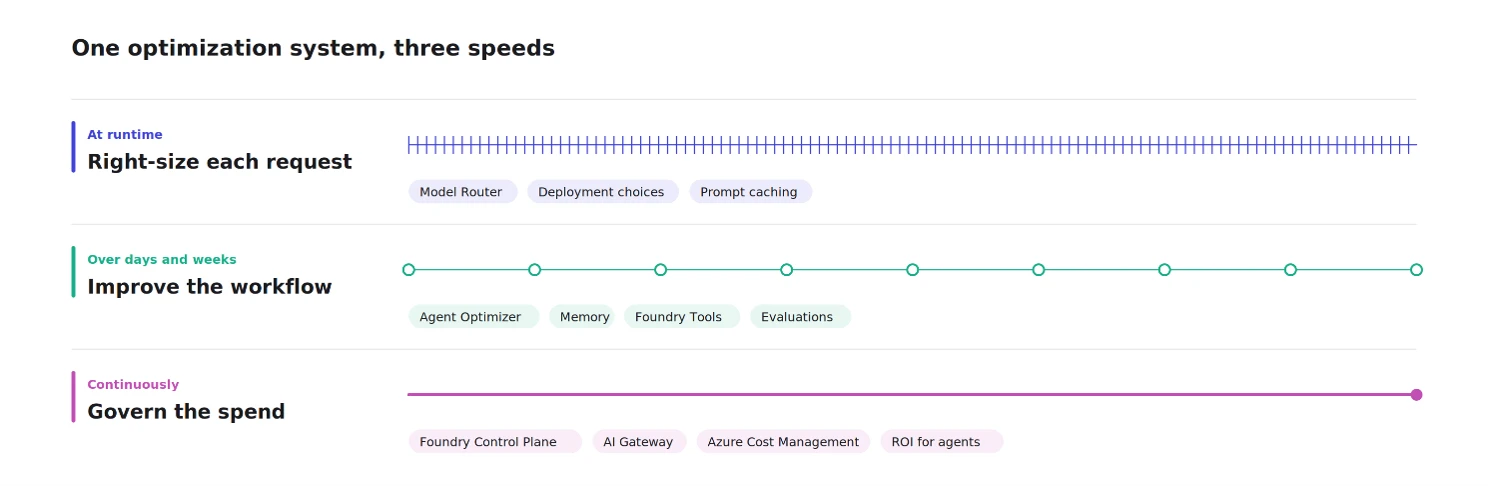
Optimization at Multiple Layers — Runtime optimizations like prompt caching and model routing combine with workflow optimizations such as memory management and automated agent tuning, allowing continuous cost improvement without sacrificing quality.

The agent cost governance cycle connects observability, spend limits, value measurement, and optimization to manage AI economics holistically.
How It Works: The End-to-End AI Agent Governance Cycle
1. See the Spend Where It Starts
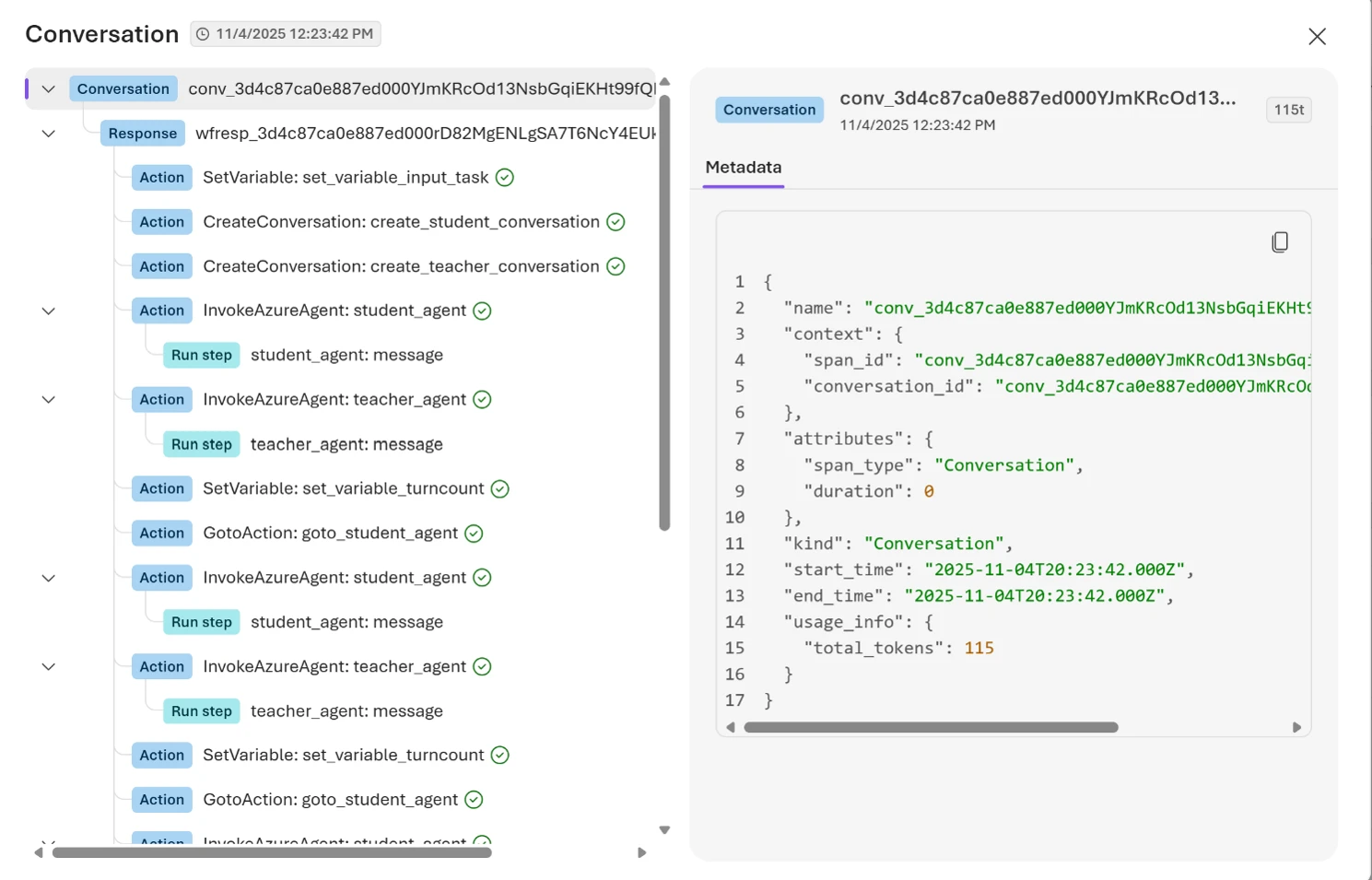
At the foundation, Foundry surfaces detailed observability signals. It captures traces of every agent interaction—logging model invocations, token consumption, tool usage, retry attempts, and latency metrics. This rich telemetry enables development and governance teams to understand where costs originate and diagnose inefficiencies.
An example screenshot from Foundry’s conversation trace interface reveals multi-agent workflows with detailed JSON metadata, making operational costs transparent and actionable.
2. Set Spend Limits at Every Layer
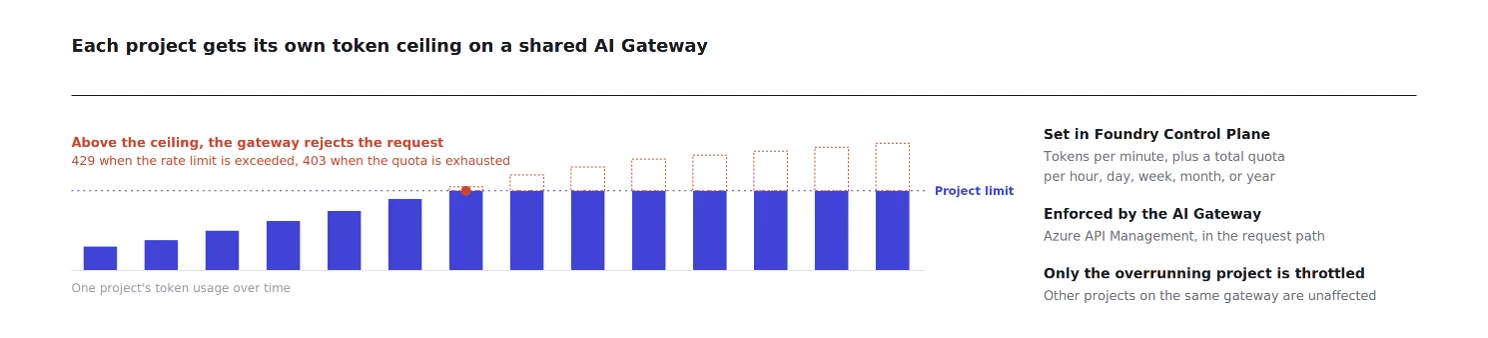
Microsoft Foundry enforces token limits per deployment via AI Gateway, rejecting requests exceeding quotas to preempt unchecked cost overruns. This technical guardrail spans multiple models and providers, keeping enterprise budgets intact.
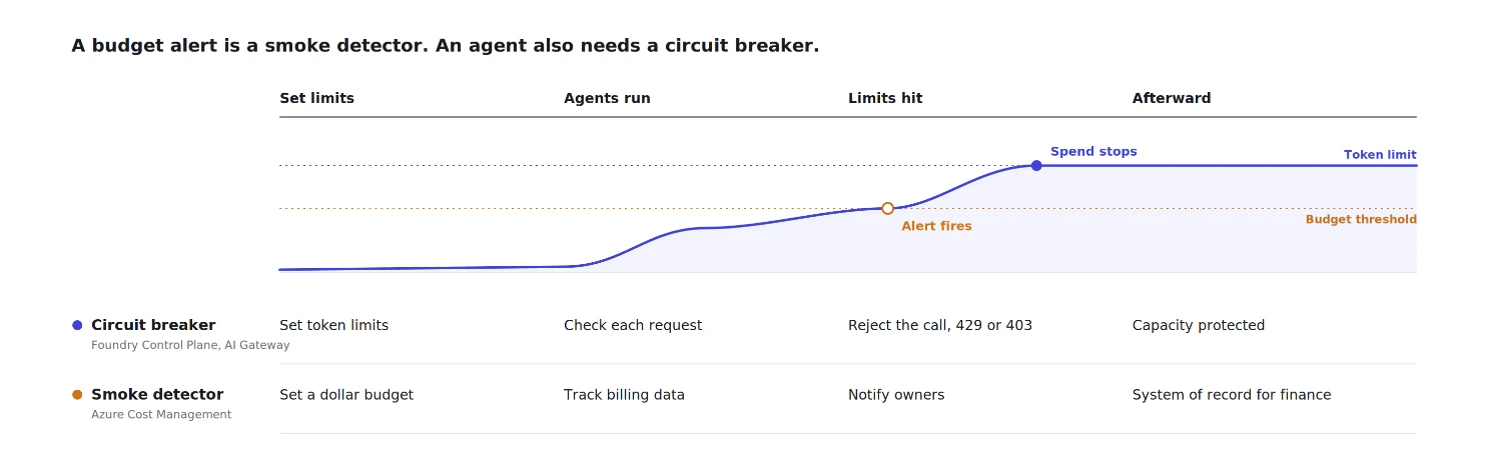
Alongside technical limits, teams create financial budgets with alerts through Azure Cost Management that notify stakeholders as spend approaches thresholds, enabling proactive interventions before costs escalate.
The combination of immediate circuit breakers and financial budget alerts acts like a "smoke detector," balancing rapid cost control with organizational accountability.
3. Measure the Value the Agent Creates
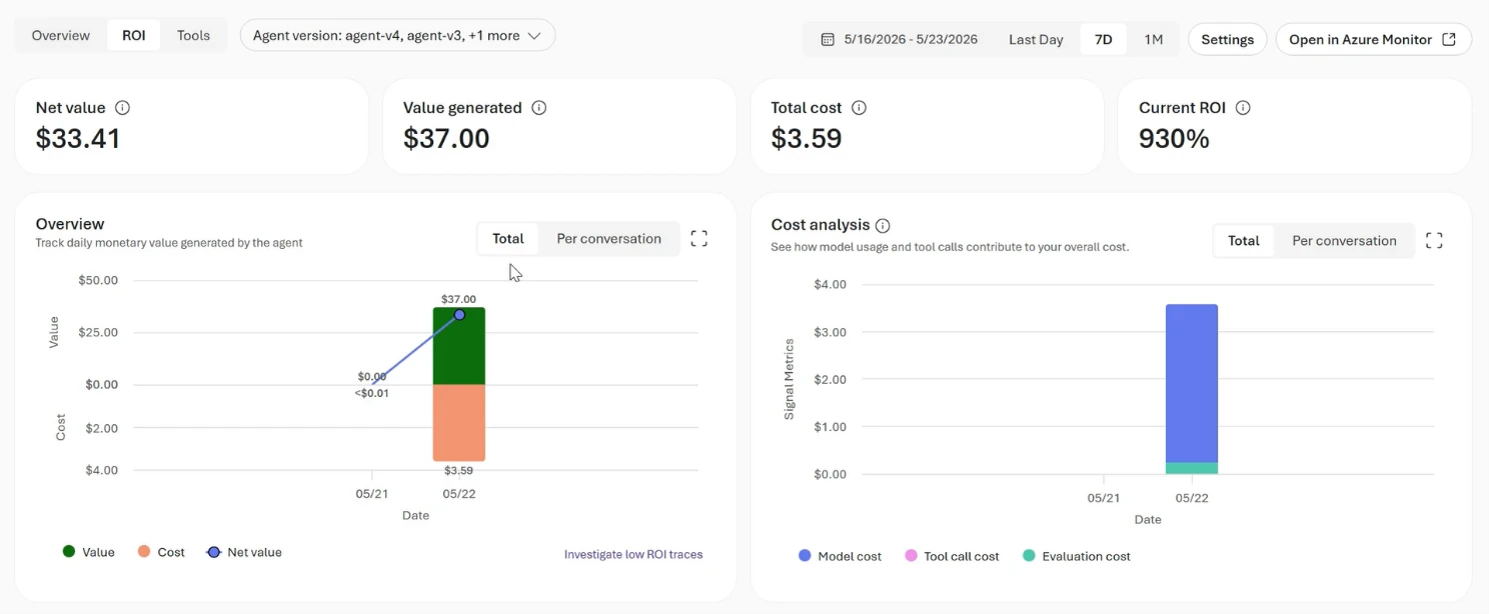
Cost alone doesn’t define success—value generated by AI agents must be quantified relative to spend. Foundry collects business outcome metrics tied directly to agent actions, then calculates:
- Value Generated: Revenue or cost savings attributed to the agent’s successful outcomes
- Total Cost: Modeling and tool expenses incurred to produce those outcomes
- Net Value: The surplus value after deducting costs
- ROI: The ratio of net value to total investment
This delivers a clear investment thesis. For example, a higher-cost agent generating greater business impact can have a superior ROI compared to a cheaper but less effective alternative.
4. Optimize, Scale, or Retire Agents Based on ROI
With continuous ROI insights, teams iteratively optimize AI agents. Foundry supports runtime tuning like model routing and prompt caching to reduce request costs, while workflow optimizations improve agent effectiveness and memory use. Agents that fail to prove ROI can be gracefully retired, freeing budget for higher-value AI investments.
Quick Tips & Tricks
-
Leverage Token Quotas Early — Set project-level token limits through AI Gateway from the start to avoid surprise spikes and enforce fair share of AI resources across teams.
-
Integrate Cost Alerts with Financial Accountability — Use Azure Cost Management budgets and alerts not just for monitoring but also to engage leadership in escalation before overruns occur.
-
Automate Quality Evaluations — Continually assess agent output quality and safety via Foundry’s evaluation tools to ensure cost savings never come at the expense of delivering value.
-
Correlate Business Metrics with AI Usage — Tie agent telemetry to concrete business outcomes to calculate net value and ROI confidently—avoid relying solely on proxy metrics like token consumption.
-
Optimize Prompt Engineering and Routing — Use prompt caching and dynamic model routing to reduce expensive API calls and minimize latency without compromising performance.
-
Adopt a Governance Control Plane — Centralize cost, usage, policy, and ROI monitoring in one platform to streamline management and foster collaboration between development, finance, and IT security teams.
Conclusion
Microsoft Foundry's AI agent governance framework answers a critical enterprise need: how to maintain strict fiscal discipline while scaling AI innovation. By marrying detailed observability with layered spend controls and rigorous ROI measurement, organizations can confidently invest in AI agents that deliver measurable business value.
This economics-driven governance lifecycle enables continuous optimization—empowering developers to innovate cost-effectively while giving leadership clear, data-driven insights into AI’s return on investment. As AI adoption accelerates, platforms like Foundry will be essential to balancing bold experimentation with responsible stewardship of resources.
The future of enterprise AI depends not only on building smarter agents but also on managing their economics with precision. Microsoft Foundry sets a new standard, making AI a truly manageable and measurable investment.
References
- AI agent governance: How to measure AI value and ROI | Microsoft Azure Blog — Original source article analyzed for this post
- Microsoft Foundry product page — Explore the AI Foundry platform
- Azure AI Gateway governance capabilities — For policies and quotas enforcement
- Azure Cost Management documentation — Managing budgets and alerts for cloud resources
- Azure OpenAI in Foundry Models — Leveraging OpenAI models within Foundry
- Foundry Control Plane Observability — Monitoring and ROI insights for AI agents