Mastering the AI-500 Exam: Your Definitive Study Guide for Multi-Agent AI Solutions
Mastering the AI-500 Exam: Your Definitive Study Guide for Multi-Agent AI Solutions
Date: 2026-07-28
Crack the AI-500 exam with expert insights on designing, building, and operating production-grade multi-agent AI solutions on Azure.
Tags: ["Azure", "AI Foundry", "Multi-Agent AI", "Microsoft Certification"]
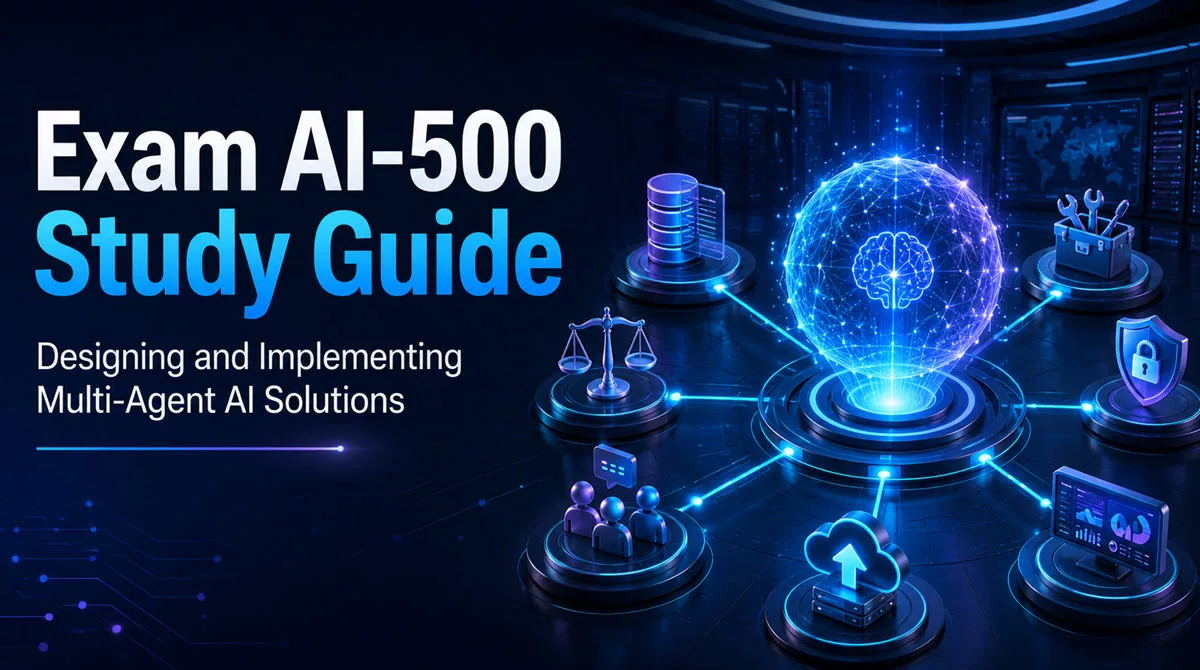
Preparing for the AI-500 certification can feel daunting. Multi-agent AI solutions have shifted the AI engineering landscape from simple, single-agent chatbots toward complex, orchestrated agent fleets managing real-world business workflows. This exam isn’t about building a single agent—that’s AI-103 territory—it’s about architecting, securing, deploying, monitoring, and optimizing a multi-agent, production-ready system your business can rely on.
The AI-500 exam validates your ability to design and implement these sophisticated agent ecosystems using Microsoft Foundry and related Azure services. In this comprehensive guide, we will unpack what the AI-500 exam entails, key differences from earlier certifications, the skills it tests, and concrete strategies to prepare effectively. Whether you are an AI engineer, solution architect, or developer stepping into multi-agent systems, this post will scaffold your path to mastery.
Let’s dive into the AI-500 exam, what sets it apart, and how to approach the preparation journey to pass confidently.
Architecture Overview
┌─────────────────────────────────────────────┐
│           Enterprise Data                    │
├─────────────────────────────────────────────┤
│  • Azure Cosmos DB & Managed Redis          │
│  • Azure AI Search with semantic & hybrid  │
│    retrieval                                │
│  • Knowledge Bases & Documents               │
└─────────────────────────────────────────────┘
                  ↓
┌─────────────────────────────────────────────┐
│        Microsoft Foundry Platform            │
├─────────────────────────────────────────────┤
│  • Agent Factory & Developer Tools           │
│  • Model Context Protocol (MCP) Servers &   │
│    Clients                                   │
│  • Agent2Agent (A2A) Protocol Support        │
│  • Multi-Tier Memory Management               │
│  • Guardrails & AI Red Teaming Agents        │
│  • Analytics & Monitoring (OpenTelemetry)    │
└─────────────────────────────────────────────┘
                  ↓
┌─────────────────────────────────────────────┐
│              Multi-Agent Solutions           │
├─────────────────────────────────────────────┤
│  • Autonomous Agents with Personas, Scopes  │
│    & Autonomy Levels                          │
│  • Orchestration Patterns (hub-spoke, p2p)  │
│  • Tool Ecosystems & Function Integrations   │
│  • Human-in-the-Loop Controls & Approvals    │
│  • CI/CD with Blue/Green & Canary Releases   │
└─────────────────────────────────────────────┘
This architecture illustrates the multilayered nature of multi-agent AI solutions examined by AI-500. Enterprise data feeds into Microsoft Foundry, which acts as the management, orchestration, and governance hub for fleets of coordinated agents built on Azure’s AI and compute services. The agents interact internally and with external tools, designed for scalability, security, monitoring, and operational excellence.
Key Technical Observations
-
Multi-Agent Systems Complexity — AI-500 moves beyond single-agent development by emphasizing architectural patterns such as hub-and-spoke, orchestrator-subagent, parallel, and peer-to-peer coordination, requiring deep understanding of decentralized workflows.
-
Protocol-Level Communication Expertise — The exam demands proficiency with Model Context Protocol (MCP) and Agent2Agent (A2A) protocols, highlighting a first-class architectural approach to inter-agent messaging and security boundaries rarely covered in typical AI certifications.
-
Advanced Memory Architectures — Candidates must design multi-tier memory systems incorporating short-term session states, shared team memory, and tenant-isolated long-term semantic memories. This layered memory design is vital for complex agent collaboration and persistence.
-
Operational Focus: Governance & Monitoring — Approximately half the exam weight covers running agents in production: implementing guardrails, tracing agent reasoning paths, detecting behavioral drift, and automated remediation — emphasizing responsible AI and reliability engineering at scale.
-
Integration and Tool Ecosystems — Implementing multi-agent RAG, MCP servers with Azure Functions or Logic Apps, and resilient error-handling showcases the hybrid AI and cloud-native development skills necessary to build dependable agent tools.
-
Release Engineering and DevOps for AI — AI-500 covers CI/CD pipelines tailored for multi-agent solutions, including canary deployments, automated evaluation gates, and blue/green rollbacks, reflecting Microsoft’s growing focus on operationalizing generative AI systems responsibly.
How It Works: Multi-Agent Solutions Under the Hood
Decomposing Business Goals into Agent Workflows
At the design phase, you break complex business objectives into workflows comprising agents, subagents, and discrete tools. Each agent is assigned a persona, autonomy level, and scope—defining responsibilities and boundaries that prevent overlap and confusion. Tool scopes, authentication, and permissions are defined to limit access and enforce Zero Trust principles.
Communication Protocols: MCP and A2A
Agents communicate via two primary protocols:
-
Model Context Protocol (MCP): A framework for building MCP servers and clients, essential for orchestrating agent workflows and tool integrations securely.
-
Agent2Agent (A2A): Enables direct peer-to-peer communication between agents supporting patterns like sequential or peer-to-peer orchestration.
Implementing these requires understanding the lifecycle of requests, identity isolation, and protocol selection to optimize latency and security.
Memory and Knowledge Integration
Agents maintain a multi-tier memory:
-
Session state: short-lived, per interaction
-
Shared team state: for collaboration across agents
-
Long-term semantic memory: persistent knowledge bases with tenant isolation policies
Retrieval-Augmented Generation (RAG) is implemented across the agent ecosystem, chunking documents, embedding for similarity search, and routing queries efficiently to relevant data powered by Azure AI Search and Cosmos DB.
Guardrails and Responsible AI
Multiple levels of guardrails protect user inputs, tool calls, and agent responses. These include:
-
Content safety filters powered by Azure AI Content Safety
-
Custom domain-specific guardrails using Microsoft Foundry
-
AI Red Teaming Agent for continuous security testing and vulnerability discovery early in the development lifecycle
Guardrails also work in tandem with human-in-the-loop mechanisms, enabling overrides and approvals where autonomous decisions could have high risk.
Observability and Monitoring
Cross-service tracing instruments agent conversations end-to-end using OpenTelemetry and Azure Monitor. Behavioral drift, quality regressions, and alerting pipelines enable automated remediation, ensuring system reliability and alignment with business SLAs. Token usage and cost analytics provide governance over large multi-agent deployments.
CI/CD & Progressive Deployment Strategies
Deployment strategies incorporate DTAP (Development-Test-Acceptance-Production) environments with blue/green and canary releases. Automated test gates based on evaluation metrics ensure only safe, high-quality agent updates reach production. Infrastructure as code and GitHub Actions streamline release automation alongside agent-specific validations.
Quick Tips & Tricks
-
Start with AI-103 Fundamentals — Although you can attempt AI-500 first, having AI-103 certification and development experience greatly eases concepts around agent tooling and memory.
-
Master Orchestration Patterns — Understand when to apply hub-and-spoke versus peer-to-peer or orchestrator-subagent based on workflow concurrency and complexity.
-
Invest in Protocol Mastery Early — Focus on MCP and A2A protocols; building robust, secure, and reliable agent messaging is foundational.
-
Design Multi-Tier Memory Carefully — Plan storage and lifecycle policies for session, team, and semantic memory to avoid data leakage and maintain context integrity.
-
Leverage Azure Monitor & OpenTelemetry — Instrument agents to enable trace correlation and behavioral analytics across distributed components.
-
Use Guardrails and Red Teaming — Integrate AI Content Safety and custom domain guardrails; adopt red team practices to spot vulnerabilities before deployment.
-
Automate Releases with Evaluation Gates — Incorporate automated behavioral and quality checks in your CI/CD pipeline to maintain governance and reduce human error.
Conclusion
The AI-500 exam represents a significant step forward in Microsoft’s AI certification landscape. It pushes candidates beyond simple agent creation into the complexities of multi-agent system architecture, security, governance, and operational excellence with a strong Azure cloud focus.
Successful preparation requires holistic knowledge—not just about coding agents but running agent fleets at scale with zero-trust security, robust monitoring, and dependable deployment. With Microsoft’s evolving learning paths, instructor-led courses, and comprehensive documentation, candidates are well-equipped to tackle this expert-level challenge.
By mastering AI-500, you position yourself at the forefront of modern AI engineering, ready to deliver scalable, trustworthy multi-agent solutions that power the AI-rich future enterprises demand.