Inside Microsoft Discovery: Revolutionizing Agentic AI for Scientific Research Workflows
Inside Microsoft Discovery: Advancing Agentic AI for Scientific Research Workflows
Date: 2026-06-02
Explore how Microsoft Discovery’s agentic AI platform supports complex R&D workflows with transparent, repeatable, and integrated scientific reasoning.
Tags: ["AI Foundry", "Microsoft Discovery", "Agentic AI", "Scientific Research", "Azure"]
Scientific research and engineering are iterative journeys involving hypothesis formation, experimentation, evidence review, and refinement integrated with institutional knowledge and domain expertise. Digital tools have historically struggled to fully capture this complexity and scale these workflows efficiently and trustworthily.
Microsoft Discovery, now generally available, addresses this gap with a comprehensive agentic AI platform designed specifically to support end-to-end scientific and engineering workflows. Unlike typical AI assistants that deliver isolated responses, Discovery orchestrates multi-agent reasoning loops across data, models, and experiments while preserving transparency, traceability, and human oversight.
In this post, we explore Microsoft Discovery’s capabilities, its architecture components as described by Microsoft, how it powers domain-specialized agent workflows, and practical usage tips. We also highlight pioneering applications from global research institutions and enterprises illustrating how agentic AI is advancing scientific workflows.
Architecture Overview
Microsoft Discovery is built on scalable infrastructure integrating AI Foundry capabilities tailored for scientific reasoning in production environments.
The platform enables flow from raw data and prior knowledge through agentic hypothesis generation, multi-modal analysis, iterative experimentation, and human-in-the-loop review.
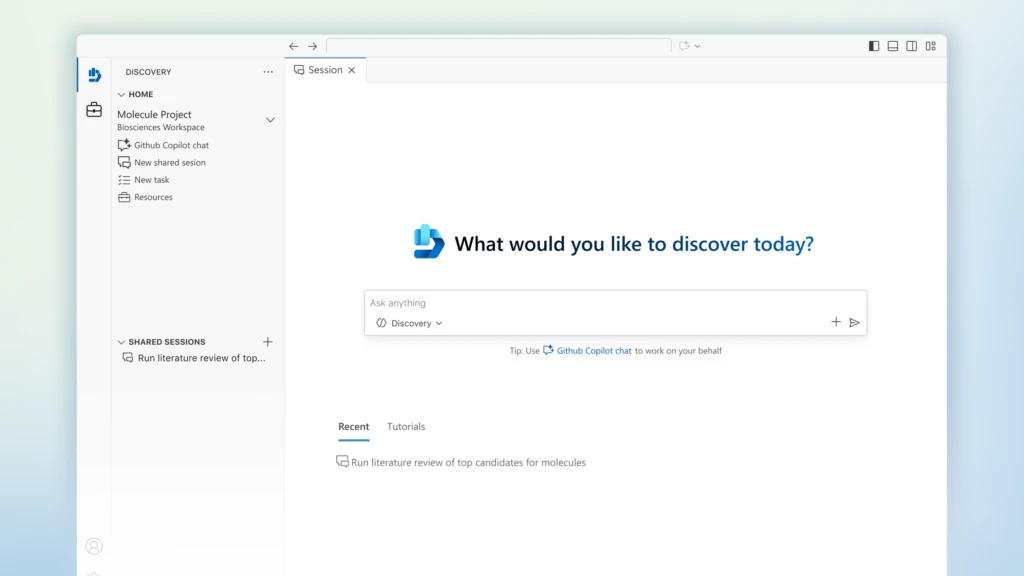
Microsoft Discovery workspace welcome experience (Source: Microsoft Azure Blog)
Key Technical Observations
-
Agentic AI Beyond Single Prompts: Discovery supports a multi-agent ecosystem where specialized AI agents collaborate across diverse data modalities, coordinated by a central reasoning engine, moving beyond linear single-model interactions.
-
Governed Scientific Reasoning Loops: The platform preserves and surfaces the full chain of reasoning with evidence citations, confidence scoring, and traceable outputs, fostering reproducibility and rigorous scientific review.
-
Integration with Institutional and External Knowledge: Discovery connects proprietary knowledge bases and domain expertise with external scientific information, enabling context-aware computations and validation.
-
Iterative Human-in-the-Loop Control: Human experts remain central, with support for expert judgment at review points, experimental design, and interpretation to ensure AI augments domain understanding.
-
Production-Ready at Scale: Microsoft Discovery addresses enterprise needs for security, governance, and operating model fit, demonstrated by collaborations with national labs and large companies.
-
Accessible Local Experience with App Preview: The Microsoft Discovery app preview provides a localized experience for researchers, students, and scientific teams to begin using Discovery capabilities without full enterprise deployment.
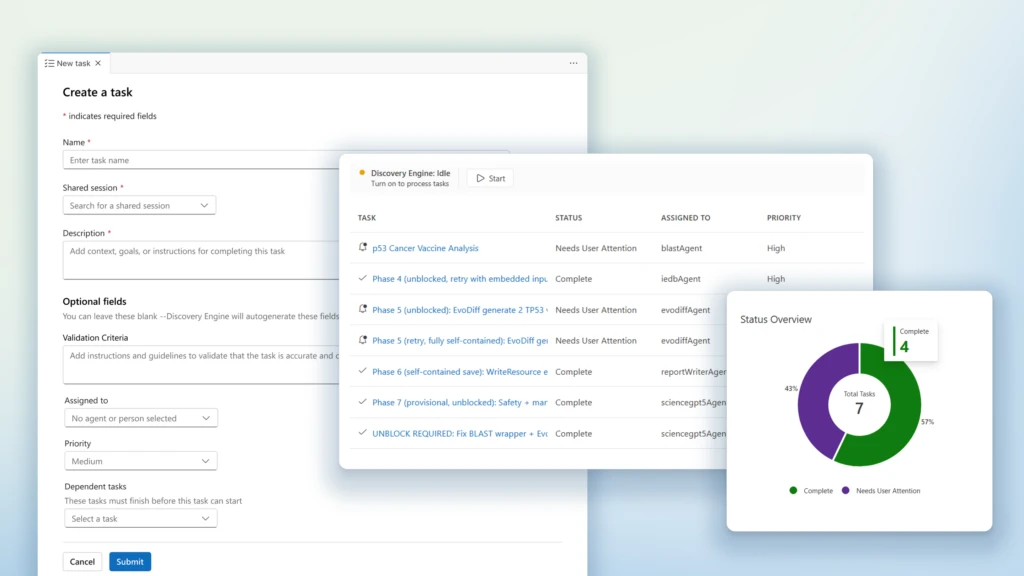
Task creation and status overview in Microsoft Discovery Engine (Source: Microsoft Azure Blog)
How It Works: The Agentic AI Loop Under the Hood
Microsoft Discovery enables organizations to define agentic workflows around their own R&D programs. Teams create and coordinate specialized agents connected to institutional knowledge and external scientific information, orchestrating work across modeling, simulation, analysis, and validation tools.
At the center is the Microsoft Discovery Engine, which supports the core loop of scientific work by moving teams from evidence to hypotheses, through execution and analysis, and into the next iteration. This loop enables repeatable, evidence-driven exploration where teams can compare tradeoffs, question assumptions, and narrow search spaces in a reviewable and repeatable manner.
Human review and governance are integral to maintaining reproducibility and trust.
Quick Tips & Tricks
-
Leverage Confidence Scoring for Prioritization
Use the Discovery Engine’s confidence and citation metrics to prioritize experimental validations and reduce effort on low-confidence leads. -
Integrate Proprietary Knowledge Early
Connect your institution’s internal databases and experiment logs for richer agent context and more relevant AI reasoning outputs. -
Use the Microsoft Discovery App for Pilot Projects
Try the preview app to explore workflows on individual or small team projects before scaling into enterprise deployments. -
Customize Agents for Domain-Specific Tasks
Develop specialized agents for unique data modalities to maximize platform value. -
Focus on Human-Agent Collaboration
Design workflows that include human review gates to maintain critical judgment at key decision points. -
Monitor Workflow Reproducibility
Use built-in governance features to ensure experimental workflows can be audited and repeated reliably.
Conclusion
Microsoft Discovery establishes an agentic AI framework for scientific and engineering R&D workflows. By orchestrating multi-agent collaboration grounded in institutional knowledge and experimental evidence, it advances AI beyond single-shot responses toward transparent, repeatable, and trustworthy scientific reasoning loops. Its general availability marks a new stage where AI acts as an intelligent research partner—scaling discovery speed while preserving human expert judgment.
The Microsoft Discovery app preview opens access to researchers at various scales, enabling incremental adoption from exploratory projects to enterprise-grade R&D programs. The growing ecosystem of partners and domain specialists promises to accelerate innovation across energy, life sciences, materials, and beyond.
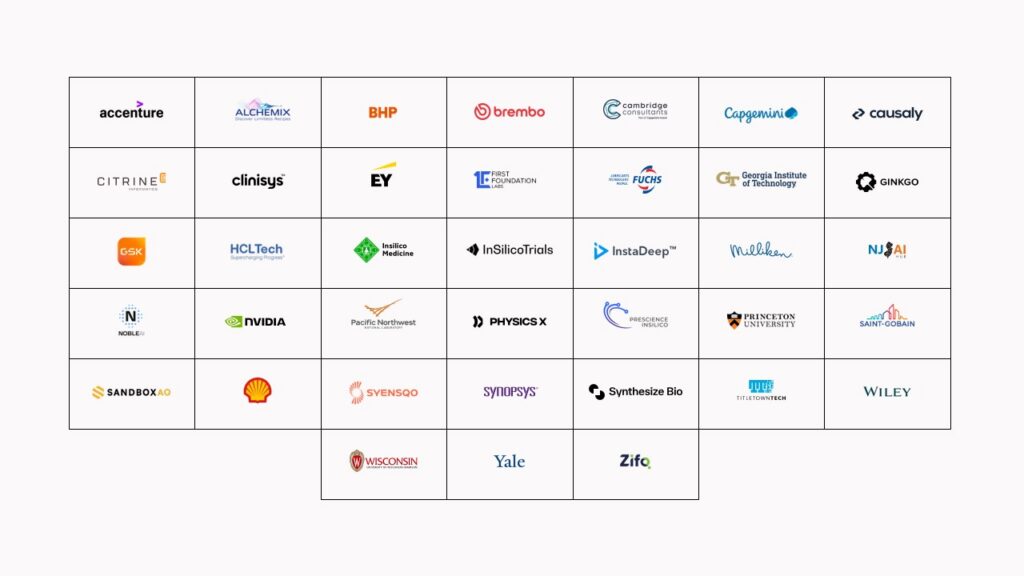
Microsoft Discovery’s growing partner ecosystem enables domain-specific ingenuity and deeper integration (Source: Microsoft Azure Blog)
References
- Announcing Microsoft Discovery general availability and Microsoft Discovery app preview - Microsoft Azure Blog — Official announcement and platform overview
- Microsoft Discovery app GitHub — Download and start using the Microsoft Discovery app preview
- Microsoft Foundry documentation — Underlying AI platform supporting agent and model management
- Microsoft Build 2026: Building agentic apps with Microsoft Fabric and Microsoft Databases — Related innovations in AI ecosystem
- Collaboration case study: Yale Engineering and Microsoft on Discovery — Example application in energy storage research
This blog post is based on the original Microsoft Azure Blog announcement: https://azure.microsoft.com/en-us/blog/announcing-microsoft-discovery-general-availability-and-microsoft-discovery-app-preview/