From Commit to Cloud: Microsoft’s Vision for the Future of PostgreSQL on Azure
From Commit to Cloud: Microsoft’s Vision for the Future of PostgreSQL on Azure
Date: 2026-05-14
Explore Microsoft’s deep investment in PostgreSQL — from upstream contributions to AI-ready cloud services — powering modern, scalable applications with open source trust.
Tags: ["PostgreSQL", "Azure", "Open Source", "AI", "CloudDatabases"]
PostgreSQL stands as a cornerstone of modern application development. From nimble startups to the world’s most demanding production environments, it has earned its place through decades of careful engineering, an active global community, and an unyielding commitment to correctness and extensibility.
As architectures evolve and AI becomes a fundamental part of software stacks, PostgreSQL continues to innovate and adapt. Microsoft’s ongoing investment reflects this reality, with hundreds of upstream commits, dedicated PostgreSQL contributors working directly on the core engine, and a growing portfolio of Azure managed services, developer tools, and community engagement programs built around Postgres.
In this post, we’ll unpack Microsoft’s strategy for PostgreSQL—highlighting upstream collaboration, cloud-native architecture innovations like Azure HorizonDB, developer tooling enhancements, and its commitment to nurturing the wider ecosystem. We’ll also explore how these efforts position PostgreSQL as a critical component in AI-driven, scalable cloud applications.
Architecture Overview
┌──────────────────────────────────────────────┐
│              PostgreSQL Ecosystem             │
├──────────────────────────────────────────────┤
│ • Open Source Core                           │
│ • Community Contributions                    │
│ • Developer Tools & Extensions                │
└──────────────────────────────────────────────┘
                   ↓
┌──────────────────────────────────────────────┐
│          Microsoft’s Upstream Contributions   │
├──────────────────────────────────────────────┤
│ • Async I/O & Vacuum Enhancements            │
│ • Query Planner & Execution Improvements      │
│ • Memory & Performance Optimizations          │
└──────────────────────────────────────────────┘
                   ↓
┌──────────────────────────────────────────────┐
│           Azure PostgreSQL Services            │
├──────────────────────────────────────────────┤
│ • Azure Database for PostgreSQL               │
│ • Azure HorizonDB (Scale‐out, Low Latency)    │
│ • Integrated AI Capabilities (Vector Search)  │
└──────────────────────────────────────────────┘
                   ↓
┌──────────────────────────────────────────────┐
│            Developer Experience & Tools       │
├──────────────────────────────────────────────┤
│ • VS Code PostgreSQL Extension                │
│ • GitHub Copilot-assisted SQL Authoring      │
│ • Migration & Performance Diagnostics        │
└──────────────────────────────────────────────┘
This architecture illustrates how Microsoft’s investment spans deep upstream contributions to the PostgreSQL core, cloud-native managed services tailored for different workload needs, and rich standalone developer tooling — all supporting a thriving ecosystem and reinforcing PostgreSQL’s ongoing maturity and scalability.
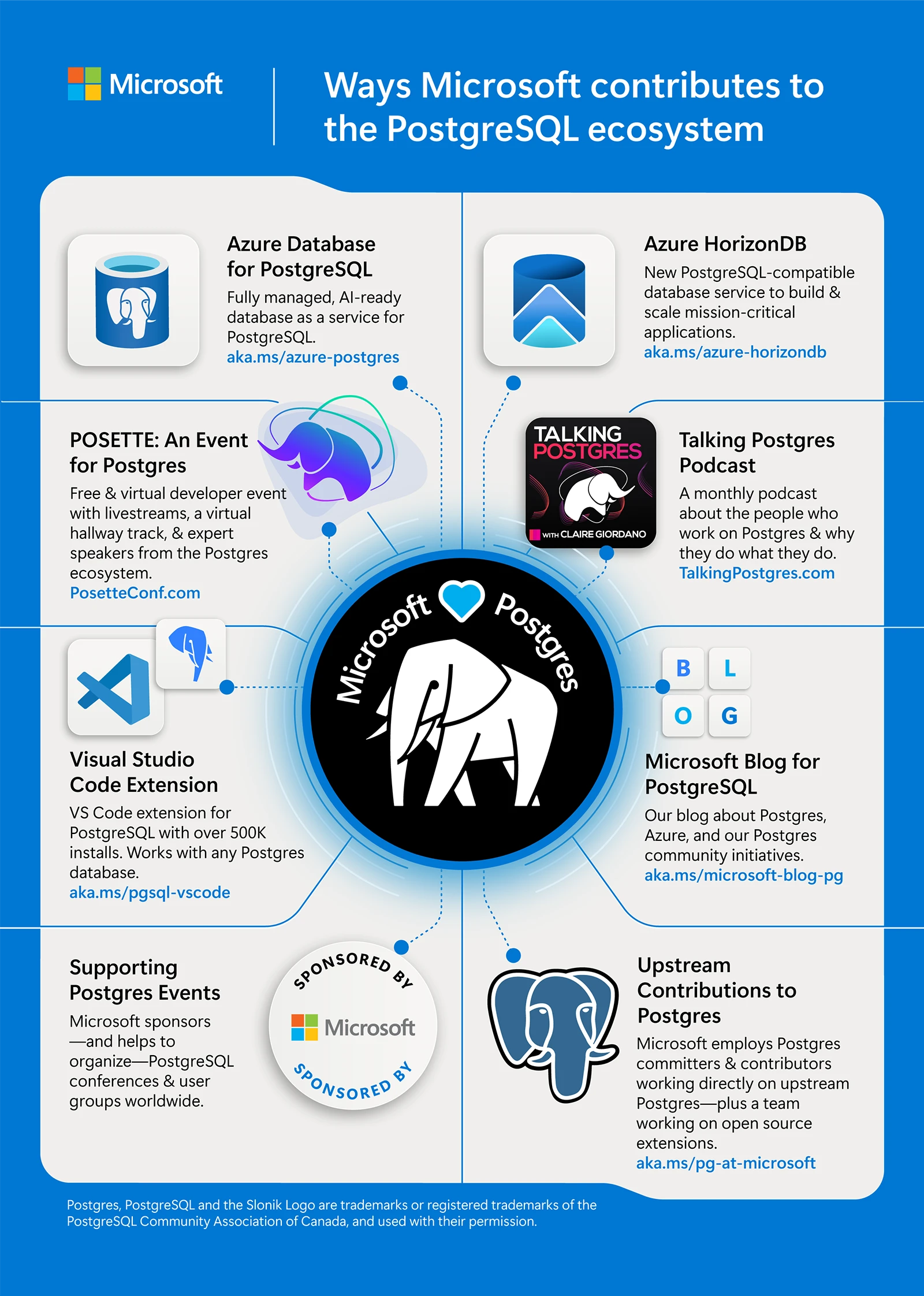
Source: Microsoft Azure Blog
Key Technical Observations
-
Upstream-first Innovation — Microsoft contributes major improvements such as asynchronous I/O foundations and enhanced vacuum performance directly to the PostgreSQL core, ensuring that benefits propagate globally rather than remain locked in proprietary forks.
-
Azure HorizonDB’s Shared-Storage Scale-Out Design — Unlike traditional sharding or single-node scale limits, HorizonDB provides horizontally scalable compute with shared storage, enabling thousands of cores with sub-millisecond multi-zone commit latencies while maintaining PostgreSQL compatibility.
-
AI-Ready Database Workflows — By integrating vector search and model invocation capabilities directly into PostgreSQL workflows, Microsoft is aligning the database layer with modern AI application demands, reducing complexity of glue code between structured data and AI inference.
-
Developer-Centric Tooling with VS Code and GitHub Copilot — Over 500,000 installs of the PostgreSQL extension empower developers with provisioning, schema exploration, and complex migration assistance, including smooth Oracle-to-PostgreSQL transformations, enhancing productivity inside familiar IDE environments.
-
Diverse Deployment Models for Varied Workloads — Supporting both Azure Database for PostgreSQL for simpler lift-and-shift workflows, and the cloud-native HorizonDB for elastic scale and resilience, Microsoft addresses a broad spectrum of customer needs without fragmenting the compatibility or ecosystem.
-
Strong Community Engagement and Ecosystem Investment — Sponsoring global Postgres conferences, producing postgresql-focused podcasts, and hosting the free virtual POSETTE event illustrate Microsoft’s commitment beyond code, nurturing contributors and users alike.
How It Works: Powering Scale and AI with PostgreSQL on Azure
Upstream Collaboration Fuels Core Enhancements
Microsoft’s team of committers actively merges improvements into PostgreSQL’s core repository. Significant contributions focus on areas that address real-world production bottlenecks observed when running at global scale, such as:
-- Example: Optimized vacuum behavior to reduce long-running table lock times
VACUUM (VERBOSE, ANALYZE);
This upstream-first approach avoids cloud vendor lock-in, promotes transparency, and strengthens the entire Postgres ecosystem.
Azure HorizonDB's Architectural Innovations
Traditional PostgreSQL deployments hit scaling ceilings due to single-node CPU and I/O limits. HorizonDB innovates with a decoupled compute-storage architecture:
- Shared Storage: Multiple compute nodes access a central storage layer.
- Elastic Compute: Scale out horizontally without sharding complexity.
- Fast Multi-Zone Failover: Replication designed for sub-millisecond commit latency across geographically distributed zones.
The key value is enabling cloud-native applications to maintain PostgreSQL compatibility while scaling to thousands of cores and global resilience.
Embedding AI Capabilities in PostgreSQL
Modern AI workloads require querying vector embeddings and invoking models closely coupled with structured data. Azure’s Postgres services integrate these features so developers can:
- Store embeddings alongside transactional data.
- Perform similarity searches respecting SQL predicates.
- Call AI inference engines natively within SQL workflows.
This fusion streamlines AI app development by collapsing layers traditionally requiring external services and glue code.
Developer Productivity at the Forefront
The VS Code PostgreSQL extension combines database operations with source control and AI-powered assistance:
-- Example assisted query editing with GitHub Copilot integration
SELECT * FROM users WHERE email LIKE '%@example.com';
Developers can provision databases, explore schemas, tune queries, and manage complex migrations (even cross-platform from Oracle) without leaving their IDE, removing operational friction while maintaining flexibility.

Source: Microsoft Azure Blog
Quick Tips & Tricks
-
Leverage Azure HorizonDB for Scale-Out Workloads
If your application demands horizontal compute scaling with PostgreSQL compatibility but worries about sharding complexity—consider HorizonDB’s shared-storage model for transparent failover and geo-distribution. -
Use Upstream PostgreSQL Features Early
Microsoft’s contributions appear first in the upstream releases—track new PostgreSQL versions closely to gain foundational improvements, like vacuum optimizations and async I/O, that can boost your application’s performance and stability. -
Enable Vector Search in Azure Database for PostgreSQL
For AI-enhanced apps, explore Azure’s native vector search extensions integrated into SQL queries, reducing latency by collocating AI data with transactional data in one database. -
Integrate VS Code PostgreSQL Extension with GitHub Copilot
Amplify your developer workflow by combining code completion and AI-driven SQL authoring assistance within VS Code. It accelerates complex query writing, migration scripts, and debugging. -
Participate in the PostgreSQL Ecosystem Events
Stay connected with the latest in PostgreSQL innovation and network with experts by attending or tuning into Microsoft-sponsored events like POSETTE and PGConf globally. -
Plan Migration with Microsoft’s Tools for Oracle-to-PostgreSQL
When migrating legacy Oracle workloads, use Microsoft’s tooling integrated in VS Code to simplify schema conversions, refactor SQL, and validate compatibility, saving significant manual effort.
Conclusion
Microsoft’s involvement in PostgreSQL goes far beyond offering a managed database service. Their deep upstream contributions help advance the entire open source ecosystem, while innovative cloud services like Azure HorizonDB unlock new scales and use cases once unreachable for PostgreSQL.
The integration of AI capabilities into PostgreSQL workflows reflects a broader vision where databases are not just storage layers but active participants in reasoning and decision-making. Combined with developer-centric tooling and broad ecosystem support, Microsoft’s strategy ensures PostgreSQL remains a trusted, evolving foundation for tomorrow’s cloud-native and AI-driven applications.
As PostgreSQL approaches its fourth decade with accelerating momentum, Microsoft’s sustained commitment underscores the importance of long-term investment and community stewardship in powering what’s next for this essential technology.
References
-
From commit to cloud: Powering what’s next for PostgreSQL | Microsoft Azure Blog — The original source detailing Microsoft’s PostgreSQL strategy and investments.
-
Azure Database for PostgreSQL — Overview of Microsoft’s managed PostgreSQL offerings on Azure.
-
Azure HorizonDB — Cloud-native scale-out PostgreSQL service powered by Microsoft.
-
VS Code PostgreSQL Extension — Developer tooling to manage and develop PostgreSQL databases efficiently.
-
POSETTE 2026 Schedule — The free annual PostgreSQL community event hosted by Microsoft.
-
GitHub Copilot — AI pair programming integration enhancing SQL authoring and migrations.