From Cloud Adoption to Value Realisation with Azure: Moving Beyond Deployment
From Cloud Adoption to Value Realisation with Azure: Moving Beyond Deployment
Date: 2026-06-08
Most cloud programmes can show what was deployed; the harder question is what got measurably better. Learn how to shift focus from Azure adoption to realizing true business value.
Tags: ["Azure", "Cloud Adoption", "Value Realisation", "FinOps", "Cloud Governance"]
A common scenario in many Azure programmes is an easy tally of what got deployed: landing zones are configured, workloads migrated, monitoring enabled, budgets and tags assigned, and security baselines applied. These accomplishments mark technical success, but they are not the finish line.
The more important, yet often neglected question is: What measurable improvements did adopting Azure bring to the organisation?
This post explores the critical journey from cloud adoption to value realisation. We will discuss why adoption alone does not guarantee business benefit, how to frame Azure roadmap activities around outcomes, and practical ways to keep value ownership alive well past go-live.
Key Technical Observations
-
Cloud Adoption Is Only the Starting Point: Deploying infrastructure, migrating workloads, and enabling monitoring are necessary but not sufficient steps. Adoption establishes what is possible but does not ensure improvements in business outcomes.
-
Technical Success Does Not Equal Business Value: Teams can demonstrate healthy workloads and compliance yet fail to prove enhanced operational or financial results, revealing a gap in ongoing benefit ownership.
-
Outcome-Driven Roadmaps Improve Clarity: Roadmap items framed purely as technical tasks (e.g., “Migrate app X”) miss opportunities for stronger justification. Adding clear, measurable expected outcomes aligns delivery to organizational priorities.
-
Ownership Must Span Delivery to Decision Making: Defining roles for delivery, operations, value proof, and decision authority is critical to maintain focus on value after projects close.
-
Leading Indicators Enable Early Feedback: Waiting on lagging metrics like cost reduction or revenue growth delays understanding impact. Azure telemetry sources such as Application Insights and Cost Management can surface actionable signals sooner.
-
Retiring Legacy Assets Is a Core Value Driver: Migrating to cloud without retiring old systems or processes only adds cost and complexity. Explicitly planning what gets decommissioned solidifies value realisation.
-
Monitoring Must Trigger Decisions: Telemetry dashboards are ineffective if seldom reviewed or disconnected from operational decisions. The purpose of monitoring is to enable timely, improved responses.
How It Works: The Value Realisation Loop
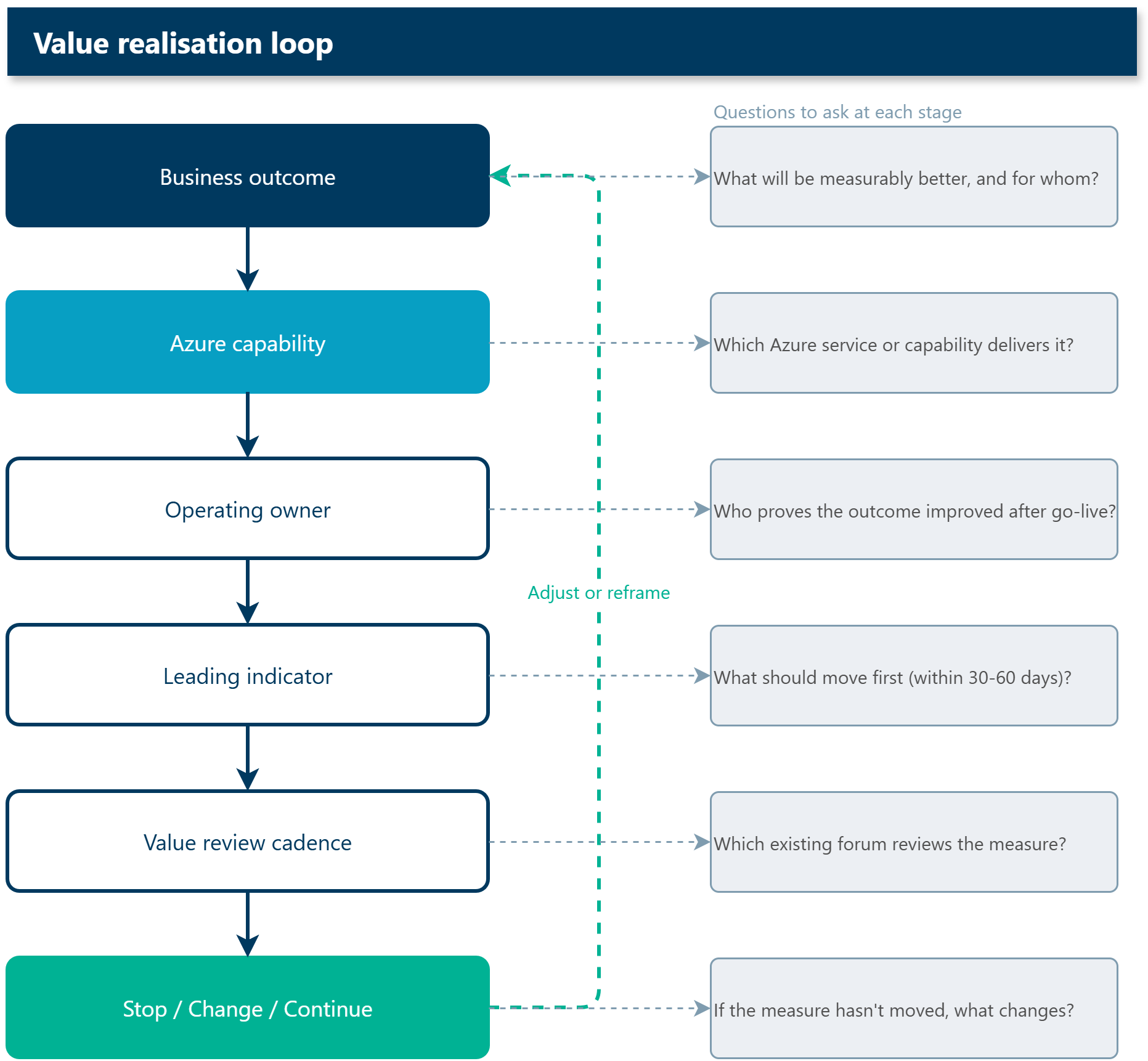
Transitioning from adoption to value realisation follows a disciplined loop that ensures continuous focus and accountability.
1. Define the Business Outcome
Start by naming what should improve, not just what gets deployed. For example:
Reduce time to recover from priority incidents
Improve monthly reporting efficiency for finance
Enhance release confidence for customer-facing applications
2. Identify the Azure Capability
Determine which Azure service or platform feature supports this outcome. Examples include:
- Deploy Azure landing zones for faster secure workload launches
- Migrate virtual machines to reduce legacy infrastructure risk
- Enable Azure Monitor and Backup to improve reliability and restore time
3. Assign Ownership
Separate roles clarify responsibilities:
| Role | Responsibility |
|---|---|
| Delivery Owner | Executes deployment and migration |
| Operational Owner | Runs and supports workloads post-deployment |
| Value Owner | Proves and advocates whether value is realised |
| Decision Owner | Makes course corrections if metrics are off |
4. Set Leading Indicators
Use early signals to detect progress before lagging metrics mature. Examples:
| Outcome | Early Signal |
|---|---|
| Faster release cycle | Deployment frequency increases in 30-60 days |
| Better reliability | Incident volume drops or MTTR improves |
| Cost ownership | Monthly cost reviews by team/product |
Azure's tools such as Azure Monitor, Application Insights, and Cost Management provide telemetry for these indicators.
5. Review on Cadence
Regular, lightweight reviews keep value in focus:
| Cadence | Purpose |
|---|---|
| Monthly Service Review | Operational health & anomaly detection |
| Quarterly Value Review | Outcome progress and roadmap adjustments |
| FinOps Iteration | Spend forecasting and economic decisions |
6. Stop, Change, or Continue
Use review outcomes to decide if the effort should proceed, pivot, or stop. This decision trigger ensures accountability and aligns ongoing investment.
Source: luke.geek.nz
Quick Tips & Tricks
-
Frame Every Azure Roadmap Item Around Value
Instead of “Deploy resource X,” describe the business outcome it enables and the operational improvements anticipated. -
Define Clear Ownership for Value Post-Go-Live
Ensure roles for delivery, operations, and value measurement exist to prevent outcome ownership from dropping post-deployment. -
Use Leading Indicators from Azure Telemetry
Leverage Azure Monitor, Application Insights, and Cost Management signals as early warnings for whether outcomes are moving in the right direction. -
Include Legacy Retirement as a Planning Item
Explicitly identify what old assets or processes will be retired to avoid cost and complexity creep. -
Make Monitoring Actionable
Ask who uses dashboards and what decisions they drive; remove or revise noisy or unused alerts. -
Keep Review Cadence Simple and Focused
Short monthly or quarterly reviews prevent drift and give opportunities to adjust course early.
Conclusion
Cloud adoption is a milestone, not the destination. While setting up Azure environments, migrating workloads, and enabling monitoring are essential, they only create the conditions for success. The true challenge lies in realizing measurable business value from these investments.
By framing Azure roadmaps with clear outcomes, explicit ownership, leading indicators, and a continuous review cadence, organizations can close the gap between adoption and value realisation. They can move beyond “what did we deploy?” to answer confidently “what did we improve?”
As cloud matures, adopting a disciplined value realisation mindset will increasingly differentiate successful Azure programmes from merely operational ones. The question to ask before every project wave should be: What will be measurably better 90 days after this goes live, and who owns proving it?
References
- From cloud adoption to value realisation | luke.geek.nz — Original article outlining the value realisation approach
- Microsoft Cloud Adoption Framework for Azure — Guidance for structuring cloud journeys
- Azure Well-Architected Framework — Best practices for workload quality
- What is FinOps? — Financial operations discipline tied to cloud
- Azure Monitor Overview — Telemetry platform for monitoring workloads
- Azure Service Groups Overview — Aligning cost visibility with business ownership
Author: Luke Murray, luke.geek.nz