Unlocking Enterprise Documents with Azure Content Understanding: GPT-5, Sync APIs, and Agentic Workflows
Unlocking Enterprise Documents with Azure Content Understanding: GPT-5, Sync APIs, and Agentic Workflows
Date: 2026-08-12
Discover how Azure Content Understanding’s August 2026 updates leverage GPT-5 series, synchronous extraction, and agentic workflows to transform enterprise document automation.
Tags: ["Azure", "AI Tools", "content-understanding", "Foundry Tools", "ai-agents"]
Extracting structured, reliable data from enterprise documents has long been a challenge for developers building AI-powered applications. Much of the world's enterprise knowledge remains entombed in diverse formats: multi-page tax forms, contracts, tables, and even images. Without efficient content understanding capabilities, automations stall on shaky or expensive extraction pipelines.
Microsoft's August 2026 update to Azure Content Understanding brings significant advancements that directly tackle this complexity. By supporting the latest GPT-5 model series, introducing synchronous Read and Layout APIs, enriching prebuilt analyzers, and debuting an agentic extraction mode, this release offers developers powerful new tools to reliably unlock structured data from rich content.
In this post, we'll explore the architectural highlights, key technical improvements, and practical workflows enabled by these updates. Whether you’re stabilizing production pipelines or building next-gen reasoning-intensive AI agents, understanding these new building blocks will help you design smarter, more cost-effective document processing applications.
Architecture Overview
┌─────────────────────────────────────────────┐
│             Enterprise Content              │
├─────────────────────────────────────────────┤
│ • Documents, Forms, Tables, Images          │
│ • Audio and Video (future expansions)       │
│ • Enterprise Knowledge Bases                 │
└─────────────────────────────────────────────┘
                     ↓
┌─────────────────────────────────────────────┐
│        Azure Content Understanding          │
├─────────────────────────────────────────────┤
│ • CU 1.0: GPT-5 Model Series Support        │
│ • CU 2.0: Sync APIs & Agentic Workflows     │
│ • Prebuilt & Custom Analyzers                │
│ • Advanced Contextualization & Semantic Chunking │
└─────────────────────────────────────────────┘
                     ↓
┌─────────────────────────────────────────────┐
│       AI Apps & Automation Agents           │
├─────────────────────────────────────────────┤
│ • Real-time Document Validation              │
│ • Complex Field Extraction & Reasoning       │
│ • Tax, Legal, Financial Form Processing      │
│ • AI Assistants & Retrieval-Augmented Generation │
└─────────────────────────────────────────────┘
The flow illustrates how diverse enterprise content feeds into Azure Content Understanding’s layered AI services. CU 1.0 serves as a proven, reliable engine optimized for production workloads, now enhanced with broader GPT-5 support and improved confidence scoring. CU 2.0 expands capabilities for higher efficiency, interactive synchronous processing, and complex agentic reasoning workflows. Downstream applications leverage these outputs for everything from compliance automation to intelligent agent interactions.
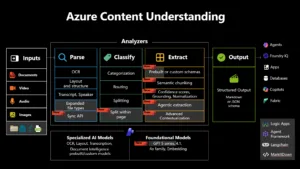
Image credit: Microsoft Foundry Blog
Key Technical Observations
-
Broader GPT-5 Model Series Integration
Expanding CU 1.0 and 2.0 to support GPT-5.1 through GPT-5.5, including mini and nano variants, empowers developers to finely balance accuracy, latency, and cost. This flexibility lets teams optimize their AI document workflows based on real workload demands without changing their API patterns. -
Grounding Efficiency Yielding Cost Savings
By merging extraction and grounding stages, the updated CU 1.0 reduces inference token consumption by up to 28% on GPT-4.1 and GPT-5.2 models. This reduces operational expense while preserving traceability to source content, a crucial factor for enterprise auditability. -
Advanced Contextualization as a Dual-Purpose Innovation
The CU 2.0 preview’s Advanced Contextualization leverages labeled example data stored securely within customer Azure storage. This approach boosts extraction accuracy by up to 3.5%, slashes token usage by 22%, and dramatically reduces token consumption for prebuilt analyzers—by up to 99%. This not only enhances quality but also drives production efficiency. -
Semantic Chunking for Improved Retrieval Context
Replacing simplistic chunking by character count or page with semantics-aware chunking helps maintain logical content grouping, benefiting retrieval-augmented generation (RAG) and multi-turn reasoning scenarios where context preservation is vital. -
Agentic Mode Enables Multi-Pass, Reasoning-Intensive Extraction
Designed for complex documents like financial filings and legal agreements, agentic mode iteratively evaluates intermediate results and cross-references evidence distributed across large documents. While this mode may increase latency and token consumption, it fills gaps where standard extraction falls short. -
Synchronous Read and Layout APIs for Low-Latency Scenarios
The introduction of synchronous operations enables immediate structured responses from Read and Layout analyzers without temporary cloud storage. This supports fast validation, real-time customer interactions, and event-driven workflows requiring prompt document insights.
How It Works: Deep Dive into CU 2.0 Preview Capabilities
Advanced Contextualization
Advanced Contextualization changes how analyzers learn and apply knowledge. Instead of embedding training data inside the model, labeled examples reside in customers' own Azure Storage. During inference, the model references this data as external context, preserving data governance and reducing token volume.
This mechanism enables:
- Enhanced extraction accuracy due to targeted context
- Lower token usage, cutting inference costs
- Easier management of training data separate from model code
This pattern fosters maintainable, scalable customization for enterprise document extraction scenarios.
Prebuilt Tax Analyzers
New tax-specific prebuilt analyzers let you process complex tax forms like 1065, 1120-S, and Schedule K-1 at scale. These analyzers use Advanced Contextualization and can process multi-page layouts with high fidelity.
The Schedule K-1 analyzer, for example, converts intricate tax data into structured JSON, streamlining downstream accounting and compliance workflows. Embedded tooling in Content Understanding Studio allows visual verification of bounding boxes and confidence scores.

Image credit: Microsoft Foundry Blog
Semantic Chunking in Document Search
Semantic chunking dynamically segments documents into semantically coherent blocks rather than fixed-size chunks. This keeps content meaningful and retrieval-ready — preserving tables with headings, splitting narrative sections cleanly, and preventing information loss during search or agentic analysis.
This approach is especially beneficial in retrieval-augmented generation setups where chunk quality directly impacts downstream inference accuracy.
Classification with In-Page Splitting and Confidence
Classifying multi-document submissions is notoriously challenging as logical documents don’t always align with physical pages. CU 2.0 preview introduces classification at a finer granularity—splitting within pages—and adds confidence scores for each classification segment.
These signals empower pipelines to decide when automated routing suffices or when to escalate for human validation, improving automation trustworthiness.
Layout Analyzer: Signature Detection and Metadata Extraction
The Layout analyzer now detects signature regions within documents and extracts metadata such as author, title, creation date, and language. This enriches the document representation with visual and contextual clues essential for workflows like contract processing and compliance.

Image credit: Microsoft Foundry Blog
Agentic Mode: Iterative Complex Extraction
Agentic mode applies an iterative reasoning engine over documents. Starting from an analyzer schema, it:
- Identifies relevant document segments spread across pages.
- Extracts candidate field values and cross-validates between sections.
- Refines final structured outputs through multiple passes.
Though costlier in latency and tokens, agentic mode dramatically improves extraction quality for documents with distributed or relational data, such as financial filings or detailed contracts.
Synchronous Read and Layout APIs
To enable real-time processing, the Read and Layout analyzers in CU 2.0 preview provide synchronous API operations. Developers can submit documents by upload or URL and receive structured results without waiting for asynchronous callbacks or managing temporary storage. This is ideal for scenarios requiring immediate AI insights, such as identity verification at onboarding or reactive customer support.
Quick Tips & Tricks
-
Select GPT-5 Model Variant to Match Workload Needs
Use GPT-5.5 for maximum accuracy-centric tasks, mini or nano variants for high-throughput, latency-sensitive pipelines balancing cost and performance. -
Leverage Advanced Contextualization to Cut Token Costs
Store labeled examples securely in Azure Storage and link them at runtime instead of embedding large training sets to optimize token consumption and governance. -
Use Semantic Chunking to Improve Retrieval Precision
Replace character-based chunking with semantic chunking in document search to preserve context and improve retrieval-augmented generation results. -
Incorporate Confidence Scores in Automation Logic
Utilize refreshed confidence models and classification confidence to build conditional workflow routing for scalable, trustworthy document automation. -
Evaluate Agentic Mode on Sample Workloads First
Due to potentially higher latency and token usage, test agentic mode on representative documents to justify cost vs. quality tradeoffs before production use. -
Use Synchronous APIs for Real-Time Document Validation
Employ synchronous Read/Layout APIs when immediate structured content is required, such as in identity checks or event-triggered workflow dispatch.
Conclusion
The August 2026 Azure Content Understanding release marks a major leap forward in tackling enterprise document extraction complexity. With expanded GPT-5 series support, richer prebuilt analyzers, and new paradigms like synchronous APIs and agentic workflows, Microsoft enables developers to build AI applications that are not only more accurate but also more operationally efficient and reliable.
Organizations can now confidently build scalable, end-to-end pipelines for tax processing, legal document analysis, and real-time interactive AI agents, powered by a platform that keeps customer control and data governance front and center.
As document-centric AI continues to evolve, these updates set a new foundation for applying advanced LLM-based understanding at scale — unlocking value in previously trapped enterprise content with agility, precision, and trust.
References
- From Sync APIs to support for the GPT-5 model series and agentic workflows: What’s new in Azure Content Understanding – August 2026 — Official Microsoft Foundry Blog announcement
- Content Understanding Studio — Explore and test prebuilt analyzers interactively
- Azure Content Understanding GPT-5 Series Guide — Deep dive on model selection, grounding, and confidence improvements
- Content Understanding Studio Documentation — Guidance on custom analyzers and structured output
- Agentic Mode in Content Understanding — Technical details on agentic reasoning workflows
- Azure Content Understanding announcements on Synchronous Operations — Details on new sync Read/Layout APIs